Myanmar

Do you have two names?  Maybe one the family uses and one for everyone else. Well Myanmar is also called Burma.  People there have no last name or family name.  So if you see Ming Ming and Mo Mo written down, you don’t know if they are brothers or friends. The men chew betel nut, which stains their teeth red, and both men and women wear longyis, a wraparound skirt.  Men tie theirs in the front and women fold the cloth over and tie it at the side.  Also, the women of the Kyan tribe wear brass neck coils around their necks from a young age.  Over the years, the weight of the brass pushes the women’s collar bone down giving them a long neck.  There are many religious places in Burma, including stupas, pagodas, temples and monasteries which were fun to explore.  The biggest book in the world is in Myanmar.  It is 1460 pages of polished marble, which is engraved with hundreds of lines of Buddhist texts.      Purrs, Gulliver

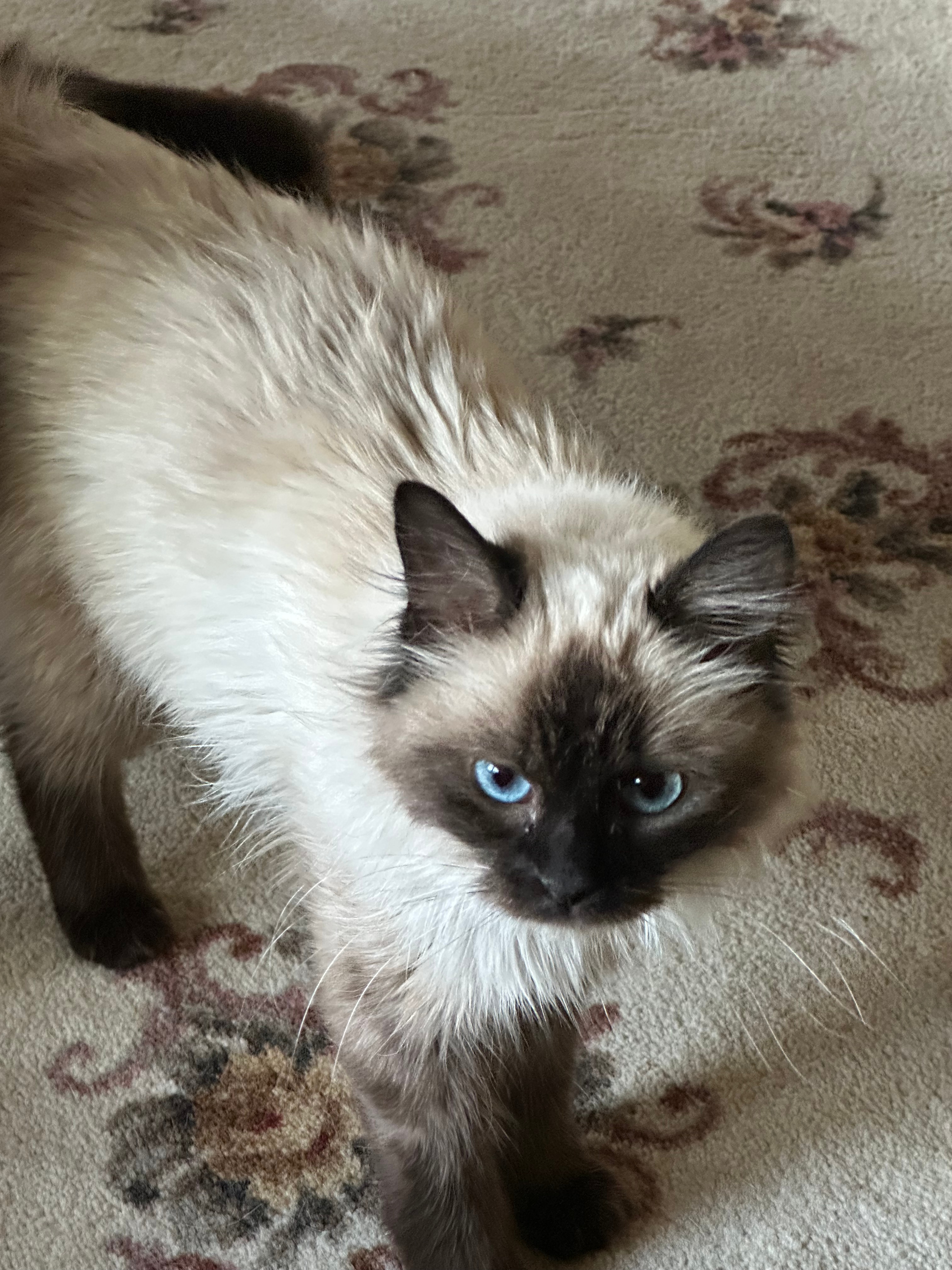
AI generated photo

Celebrating National Postcard Day!

Photo by human slave Carol K. Lou is standing in for Gulliver who is stalking prey through the super secret spy agency.

World Postcard Day is October 1, 2025 and I plan on celebrating by sending extra postcards to people through Postcrossing.com. Postcrossing is for those who like to send and receive real mail and are happy to write to strangers. My mom calls it “snail mail “ because it is not instant like email. You request as address which is given randomly from the 809,000+ active participants around the world and then you write to that person. When they receive the postcard they go online and register it using an id number on the postcard. They do not send a postcard back, but are given a different address to send their postcard to, and so on down the line. So it is not a penpal program and you can write about your hobbies, family, books you have read or favorite movies or anything that you think the recipient may enjoy reading. Postcrossing started World Postcard Day in 2019 to celebrate the 150 anniversary of the first postcard.

To quote the Postcrossing website :“Introduced in 1869 as a way of sending a simple message, postcards quickly evolved beyond their practical purpose to become the universal souvenir that brightens everyone’s mailboxes.”

Purrs, Gulliver

Lady Tumbleweed

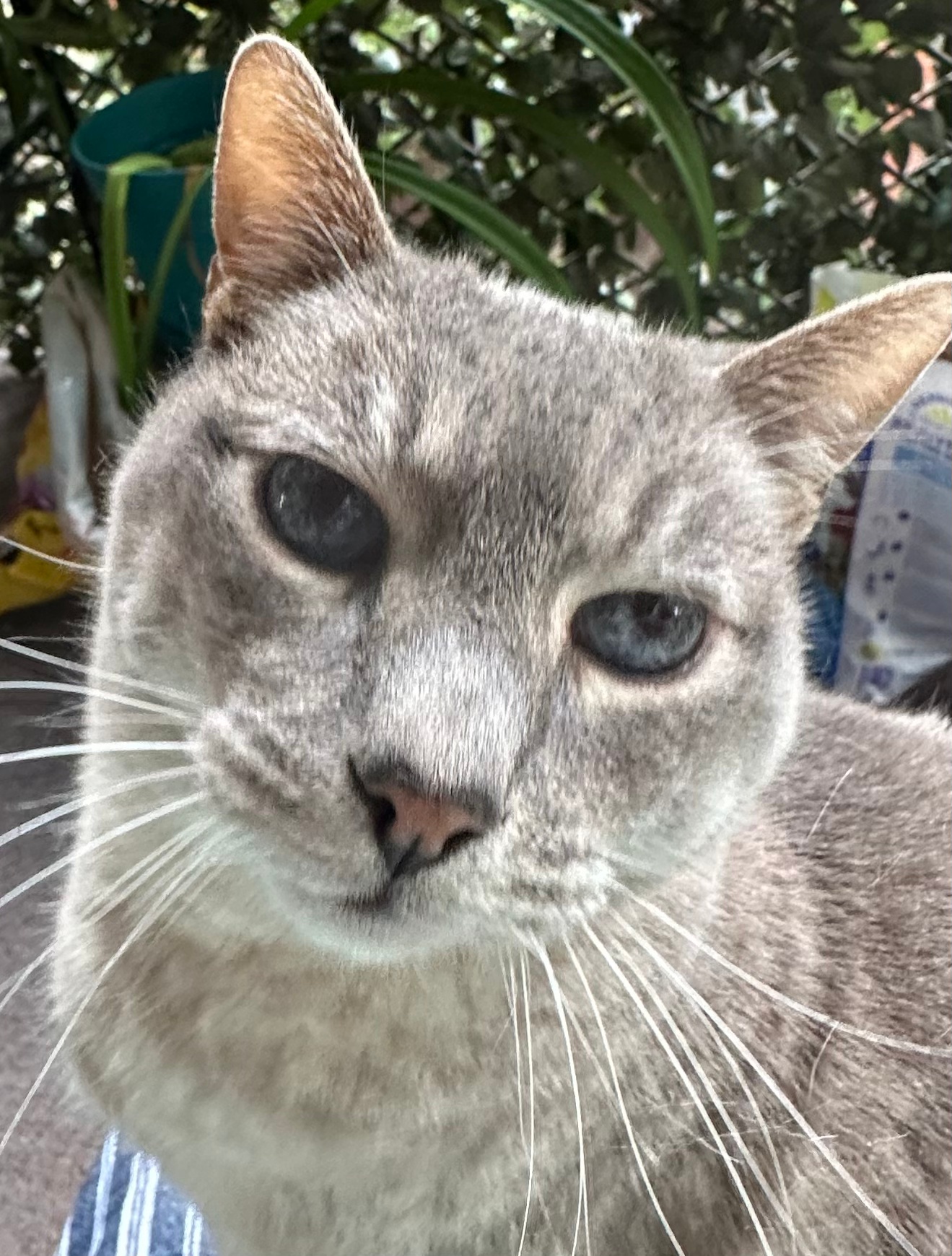
Greetings!  My name is Circe, code named “Lady Tumbleweed”. I am Sir Gulliver of Dorito’s new little sister.  Did you know all cats have superpowers? In Germany, cats are associated with independence and magic.  Cats purr at frequencies between 25-150 Hz, which is the ideal frequency to help heal bones and tissues and we have over 100 vocal sounds while dogs have only about 10.  We are much more expressive communicators, which is why we are ideal as supersecret spies! We can run up to 48 KM/h in short sprints- almost as fast as a car and we can jump up to six times our body length in a single bound.  Because these superpowers take so much energy, cats spend about 70% of their lives sleeping (recharging), which means a 9-year-old cat has slept 6 years of its life and is only awake 3 of the nine years.  The world’s oldest cat lived to be 38 years old!  I am still a kitten, so I have many years of spying and postcards ahead of me. 

Whisker wiggles, Lady Tumbleweed.

Hiding as a spy

Hiding in plain sight is a large segment of the super-secret spy training. My friend Bubba mastered this art early in his career.  He chose a high school in San Jose, CA.  Bubba became a model student, often the first one to school, waiting for staff and students to arrive. He would sit quietly in the back of classrooms, wandering in and out, and would spend many hours in the stacks of the library eavesdropping as well as reading a great deal.  Bubba monitored the athletes on the sports fields and memorized their play books. Soon, the high school students gave him his own school id card and wrote about him in the school’s newspaper. Bubba is now retired from spying and was recently nominated to the Super-Secret Spy Hall of Fame for his work.  Even retired spies don’t like having their picture taken, though I will tell you he is also an orange and white cat.  Purrs, Gulliver

Racoon

This is a favorite story of mine on how the raccoon got his markings.

“Stop, Thief!  cawed the Raven, who saw someone in a mask running away from his home.  Raven could see a torch in the thief’s hands and hear the jingle of the beautiful silver bracelets he had stolen himself some years back.  The next day he went to each of the forest animals – Bear, Owl, Eagle, and Chipmunk – but none seemed to know anything about the missing jewelry. Finally, Raven visited Raccoon.  

At that time, the Raccoon was all grey, from nose to tail. “Someone has taken five silver bracelets from me,” Raven said. “Do you know anything about that?” “No, I don’t.” Raccoon snarled. Raven apologized and thanked Raccoon, but when Raccoon turned his back, Raven saw five dark rings of tarnish on his tail.

“Ah hah!” Raven said. “It was you!” Raccoon was contrite and admitted what he had done, but Raven didn’t think that was enough. “From now on,” Raven said, “everyone will know you are a thief. Your face will show the mask with which you hid yourself, your hands will be blackened by the ash from your light, and your tail will always have rings stained on it. And so it was. 

Raccoon never really stopped his thieving ways. He still comes out at night looking for things he can take, wearing his bandit’s mask and dirty paws.  Purrs, Gulliver

Hansel the Rooster

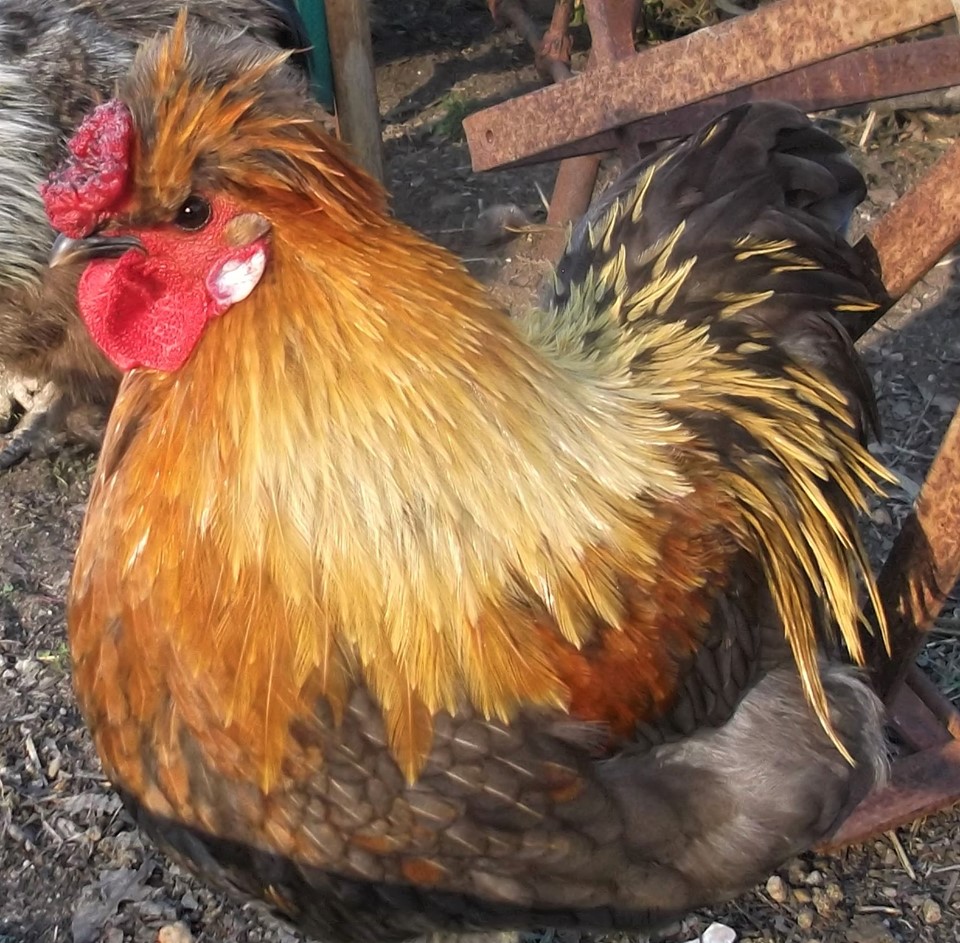
Which came first, the chicken or the egg? Why did the chicken cross the road?  “Stop with the jokes,” Hansel clucked. “I have a long history of famous ancestors.” Chickens (and their eggs) are native to India and Southeast Asia. The earliest tame chickens date at least back to 7,000 years ago.  In ancient times chickens were used in religious ceremonies and for fortune telling.  About 2000 years ago the Egyptians learned to hatch chicken eggs by keeping them warm in baskets over hot ashes.  Chickens multiplied like crazy and went from a rare bird to becoming an everyday meal.  From India to the Middle East to Europe and beyond, the fowl has migrated around the world with people.  “So you see how important the chicken is to humans.” Hansel crowed.    I’m glad Hansel is my friend and will never end up as someone’s dinner.  Purrs, Gulliver.  

Hong Kong

Now that I have caught up on all the catnaps I was missing, I will tell you more about my time in the super-secret spy training.  All trainees had to live in foreign countries for much of their training. My first assignment was in Hong Kong. I was there over the holidays of Thanksgiving and Christmas and missed home terribly.   Hong Kong means Fragrant Harbor in Chinese and is not just one island, but over 260. It started as a fishing village and was populated 30,000 years ago.  Now it is one of the most densely packed cities in the world.  One of my favorite memories was going out with friends and having snacks called “Dim Sum”, which in Cantonese means “touch the heart”.   Purrs, Gulliver

Cats take over the world

First it was the mice, now it is the birds that are spreading rumors. They are chirping and hooting that cats want to run everything. Who wants the responsibility?  We already have people as slaves. Cousin Sasha gets 12 meals a day plus treats, unlimited catnip, cat naps whenever she wants, a maid to clean her litter box and pick up her toys and a warm bed every night.  Who says we have not already reached the peak of leadership?  My big brother Smokey even keeps the dogs at home in line with just a sharp hiss and well-placed swat occasionally.  I have some great mentors to follow as I grow older. I can CATegorically state cats are not planning to take over the world. Sir Gulliver of Dorito.

Meowing in 14 different languages

I mentioned as part of supersecret spy training that I learned to meow in 14 different languages.  You would think they all sound the same, but each language has different rhythms, tonal variations, or can be soft, hard or guttural, to name a few differences. French, Spanish, German, Portuguese, and Italian all sound like mee-ow.  Russian was more difficult -spelled Мяу! (M’yau!)  and pronounced “m-yow”. Greek was also hard to pronounce properly, it is spelled Μιάου! (Miáou!) and sounds like mee-ah-oo. Norwegian and Swedish sounds similar – my-ow but when it came to Icelandic, I had to switch to myah.  Then there were the languages I had more trouble with.  Cherokee was the hardest (Gihiya!) spoken gee-hee-yah, Zulu: Ngiyavuma! said asng-ee-yah-voo-ma and Hungarian spelled Nyávog and pronounced nyah-vohg. Even though I don’t use the different meows daily, it is fun to speak with cats in their native language.  Purrs, Gulliver

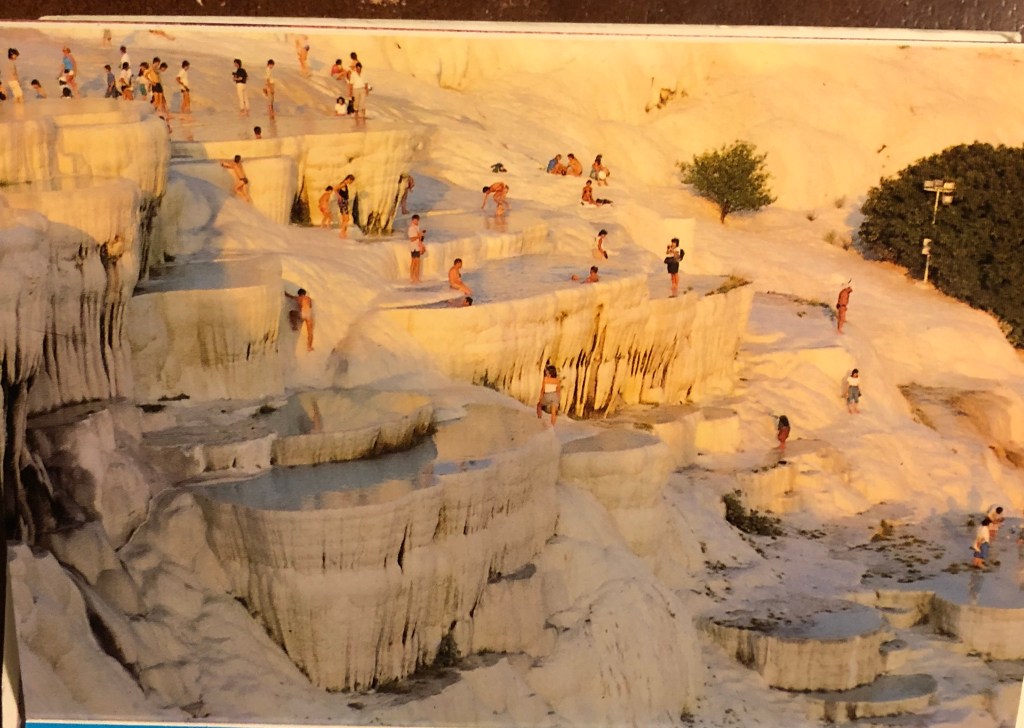
Pamukkale, Turkey

“I know most cats don’t like to get into water, but you have to try our famous thermal springs. You will feel like you have been to a luxurious spa” said my friend Bas, a purebred Van Kedisi cat. A native of Turkey, he is pure white but has the unusual trait of two different colored eyes.  He invited me back to Turkey after we had so much fun on my previous visit. This time we went to southwest part of Turkey to Pamukkale which means Cotton Castle. Legend has it that the limestone formations are solidified cotton that giants left out to dry. Everyone had to go barefoot to prevent damage to the pools; it was a slippery trip to the 17 pools to enjoy the naturally heated water just like Romans did thousands of years ago. The minerals in the pools, formed by underground hot water sources, are said to help with all sorts of illnesses, especially digestive and circulation problems.  The ancient city of Hierapolis was a large city built nearby, there plenty of well-preserved ruins we explored including a restored amphitheater. Nearby, there’s also an archaeological museum for those that are interested in the history of the area.  Bas was right, soaking in the warm pools felt good after hiking around the ruins.  Purrs, Gulliver